
Air Fryer vs. Convection Oven: What’s the Difference?
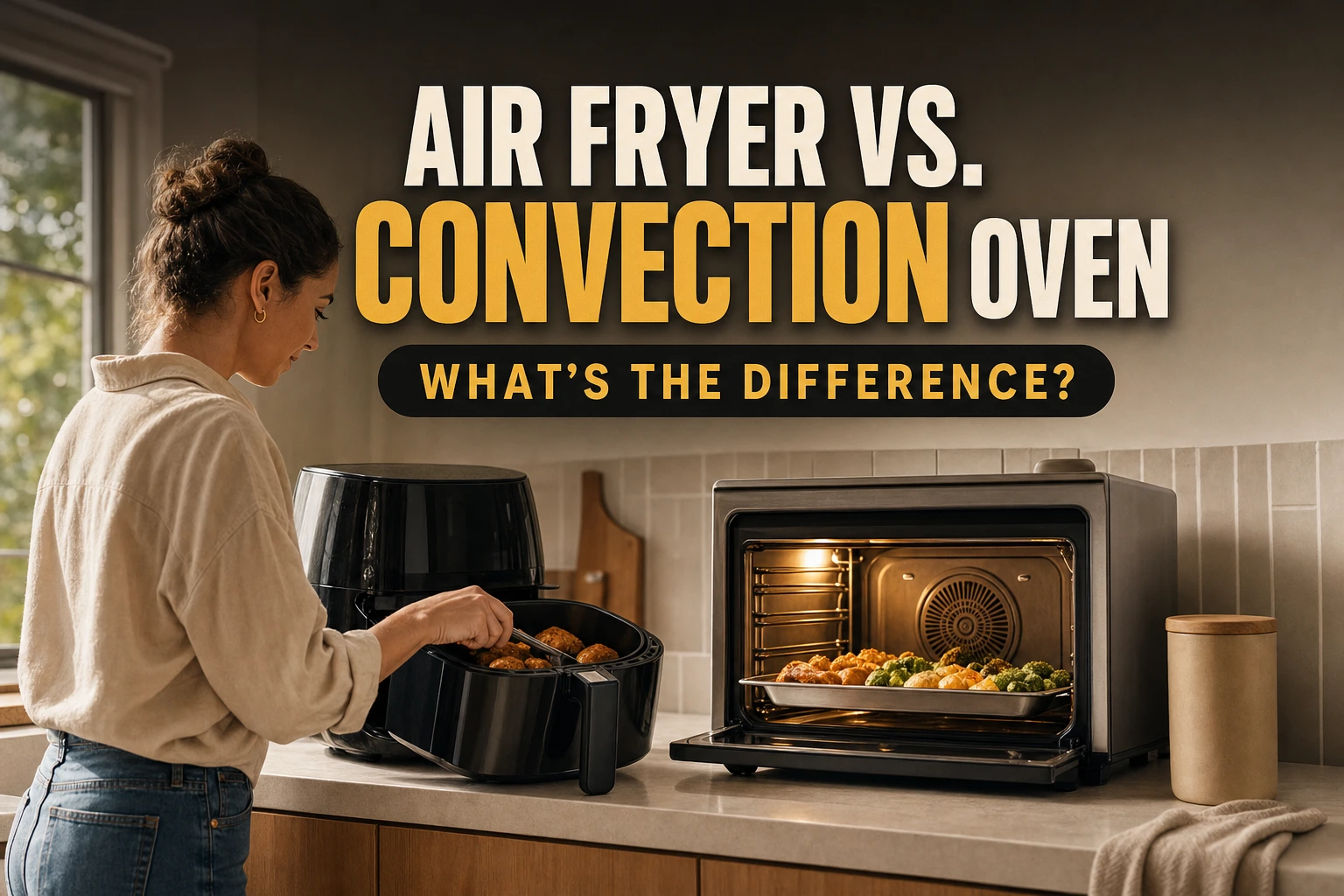
An air fryer and a convection oven both circulate hot air, but they differ in chamber size, airflow, capacity, speed, and the types of cooking they handle most conveniently.
This article is informational and does not place shopping buttons in the story. Related buying guides may include affiliate links.
As an Amazon Associate I earn from qualifying purchases. This does not affect the price you pay. Affiliate disclosure
On this page11 sections
- 1The short answer
- 2What Is the Difference Between an Air Fryer and a Convection Oven?
- 3How Air Circulation and Browning Differ
- 4Size, Capacity, and Cooking Space
- 5Preheating, Cooking Time, and Energy Use
- 6Cooking Results and the Foods Each Handles Well
- 7Which One Should You Pick?
- 8How to Convert Oven Recipes for an Air Fryer
- 9Sources and Further Reading
- 10Frequently asked
- 11Sources
The short answer
- Air fryers cook faster due to a high-speed fan and compact cooking basket.
- Convection ovens offer much larger capacities, making them ideal for cooking multiple dishes at once.
- Air fryers excel at mimicking deep-fried textures with minimal oil compared to traditional ovens.

The difference between an air fryer and a convection oven is that an air fryer circulates hot air around food in a small chamber, while a convection oven moves hot air through a larger oven cavity. Both use convection technology, but air fryers generally suit small portions and crisp foods, whereas convection ovens offer more room for baking and batch cooking.
Under the hood, both appliances rely on convection technology—which simply means using a fan to blow hot air around. However, the scale of this air movement differs between a portable basket on your counter and a full-size oven. Deciding which one to use, or whether to own both, depends on the quantity of food you prepare, the results you want, and how quickly you want your meals on the table. Understanding these differences can prevent you from purchasing unnecessary duplicate appliances.
What Is the Difference Between an Air Fryer and a Convection Oven?
An air fryer is essentially a compact convection appliance, but its shape and cooking setup distinguish it from a conventional fan oven. Food usually sits in a perforated basket or on a vented tray, allowing heated air to reach more of its surface. A convection oven has a much larger cavity and generally uses racks, baking sheets, or roasting pans.
According to Good Housekeeping, both appliances circulate hot air, while an air fryer’s compact chamber helps food cook and crisp quickly. The practical difference is therefore not simply whether a fan is present. Chamber size, food placement, airflow, and usable capacity all affect how each appliance cooks.
These design differences also influence daily use. An air fryer can be convenient for a side dish, snack, reheated portion, or meal for one or two people. A convection oven provides room for larger cookware and more food at once. The right choice depends less on the appliance label than on the amount and type of food you usually prepare.
How Air Circulation and Browning Differ
At the heart of both appliances is a fan that circulates heated air. Because the air fryer's cooking chamber is highly concentrated, heat can reach food quickly. Its perforated basket also exposes more of the food to moving air than a solid baking sheet would. This setup encourages surface moisture to evaporate and supports browning, especially when food is arranged with space around each piece.
In contrast, a convection oven distributes heat across a wider space. It can still brown and crisp food, particularly if you use a wire rack or perforated tray, but a large cavity may take longer to produce a similar result. The Air Fryer Insider notes that airflow and compact cooking space help explain why air fryers often crisp small portions effectively. Neither appliance truly fries food in oil; both cook primarily with heated air.
Airflow can be restricted in either appliance. An overcrowded air-fryer basket leaves less space for moving air, while a deep or tightly packed pan can have a similar effect in a convection oven. Turning food, shaking a basket, or rotating a tray may improve exposure, depending on the recipe and the manufacturer’s instructions.
 See the picks in our buying guide
Size, Capacity, and Cooking Space
Capacity is the most obvious structural difference between the two appliances. Air fryers are designed around a relatively small basket, drawer, or compact oven-style cavity, which can limit their use to smaller portions. Crowding the basket in an air fryer blocks the airflow and defeats its primary purpose. Cooking in batches may therefore be necessary if food cannot be spread out with room for air to circulate.
Convection ovens, on the other hand, can accommodate larger baking sheets, roasting pans, or several dishes, depending on the oven and rack arrangement. If you regularly feed a large family or meal prep for the week, the volume of a convection oven can be more practical. If you mostly cook snacks, side dishes, or one or two portions, an air fryer may use its available space more efficiently.
Usable cooking area matters more than a headline capacity alone. Basket shape, rack position, handle placement, and the need to leave space around food can affect how much fits in one layer. In a convection oven, pan dimensions and clearance between racks also matter. Compare the food you actually cook rather than assuming every appliance with a larger stated cavity will hold it conveniently.
Preheating, Cooking Time, and Energy Use
Because of its small interior volume, an air fryer commonly preheats faster than a full-size convection oven, and some recipes do not require a separate preheat. The heating element is also close to the food, so small servings can begin cooking quickly. Good Housekeeping identifies speed as one of the practical advantages of the compact air-fryer format.
A convection oven must bring a larger cavity and its internal surfaces up to temperature. That extra space can make it less convenient for a small, spontaneous cooking task, but the comparison changes when you need to cook a large quantity. An air fryer may require several batches, while a convection oven can sometimes cook everything at once. Total energy use therefore depends on appliance wattage, preheating, cooking time, portion size, and whether multiple air-fryer batches are needed; it should not be judged by appliance type alone.
Cooking times should be treated as estimates rather than direct equivalents. Fan strength, heating-element position, food thickness, starting temperature, and basket or pan load can all change the result. Check food early when adapting a recipe, and follow the appliance manual for preheating and cooking guidance.
Cooking Results and the Foods Each Handles Well
Air fryers are especially useful for foods that benefit from exposed surfaces and steady airflow, including fries, wings, breaded items, roasted vegetables, and reheated leftovers. Results are usually more even if pieces are kept in a single layer or the basket is shaken or turned during cooking. Food may still need a light coating of oil for flavor and browning, depending on the recipe.
Convection ovens are more versatile for large-format cooking. Their racks and wider cavity suit sheet-pan meals, larger roasts, casseroles, cookies, and other baked dishes. A convection fan can improve heat distribution, although some delicate baked goods may be better prepared with a conventional setting if the oven provides one. Recipes also vary: follow the appliance manufacturer’s guidance rather than assuming an air-fryer time and temperature will transfer unchanged to a convection oven.
Cookware is another practical distinction. Convection ovens generally accept standard oven-safe pans that fit the cavity. Air fryers require cookware that fits without obstructing the airflow or contacting parts it should not touch. Consult the manual before using a pan, liner, or accessory, because basket designs and permitted materials vary.
Which One Should You Pick?
Your decision should come down to your cooking habits and household size. Choose an air fryer if you frequently cook quick meals for one or two people, love crispy textures like french fries or chicken wings, and want to minimize prep time. Opt for a convection oven if you cook in large batches, bake delicate pastries regularly, or already have a modern oven equipped with a convection setting.
Owning both may still make sense if they serve separate roles: the oven for larger meals and baking, and the air fryer for small portions or reheating. Before adding another appliance, try using a wire rack or perforated tray in your convection oven and compare the results with the foods you prepare most often. If you decide a separate appliance suits your routine, continue to our informational buying guide, “Best Air Fryers of 2026: 4 Research-Backed Picks.”
Also consider storage, cleanup, and workflow. A countertop air fryer needs accessible space and usually has a removable basket or tray to wash. A built-in convection oven occupies no extra counter space but may be less convenient for one small serving. These practical details can matter as much as minor differences in cooking speed.
How to Convert Oven Recipes for an Air Fryer
Treat any oven-to-air-fryer conversion as a starting point rather than a fixed formula. Air fryers vary in chamber shape, fan behavior, heating-element position, basket design, and available cooking modes. A recipe written for a large oven may brown sooner in the smaller appliance, so check the food earlier than the original instructions suggest.
Reduce the batch size enough to preserve airflow, especially for foods intended to become crisp. Keep pieces separated where practical, then shake the basket or turn the food if the recipe and appliance instructions call for it. Cakes, breads, casseroles, and other foods that require a pan need suitable cookware with clearance around it.
Manufacturer instructions should remain the first reference. They can clarify whether preheating is recommended, which cookware is compatible, and where a rack or tray should sit. This companion topic supports the broader comparison by showing why times and temperatures do not always transfer unchanged between the two appliances.
Sources and Further Reading
This comparison draws on appliance explainers from Good Housekeeping and The Air Fryer Insider. Good Housekeeping compares the design and cooking behavior of air fryers and convection ovens, while The Air Fryer Insider discusses how compact chambers and airflow affect cooking results.
Good Housekeeping: https://www.goodhousekeeping.com/appliances/a33403402/air-fryer-vs-convection-oven/
The Air Fryer Insider: https://theairfryerinsider.com/guides/air-fryer-vs-convection-oven/
For more practical guidance in the Air Fryers category, read the companion section “How to Convert Oven Recipes for an Air Fryer” above. It explains how to treat recipe conversions as starting points, account for smaller batches and faster browning, and check food early rather than presenting one adjustment as universal. Manufacturer instructions should remain the first reference because controls, fan behavior, basket design, and cooking modes differ by appliance.
Frequently asked
Sources

As an Amazon Associate I earn from qualifying purchases. This does not affect the price you pay. Affiliate disclosure