Dumbbell Adjustable Rack: How to Choose One
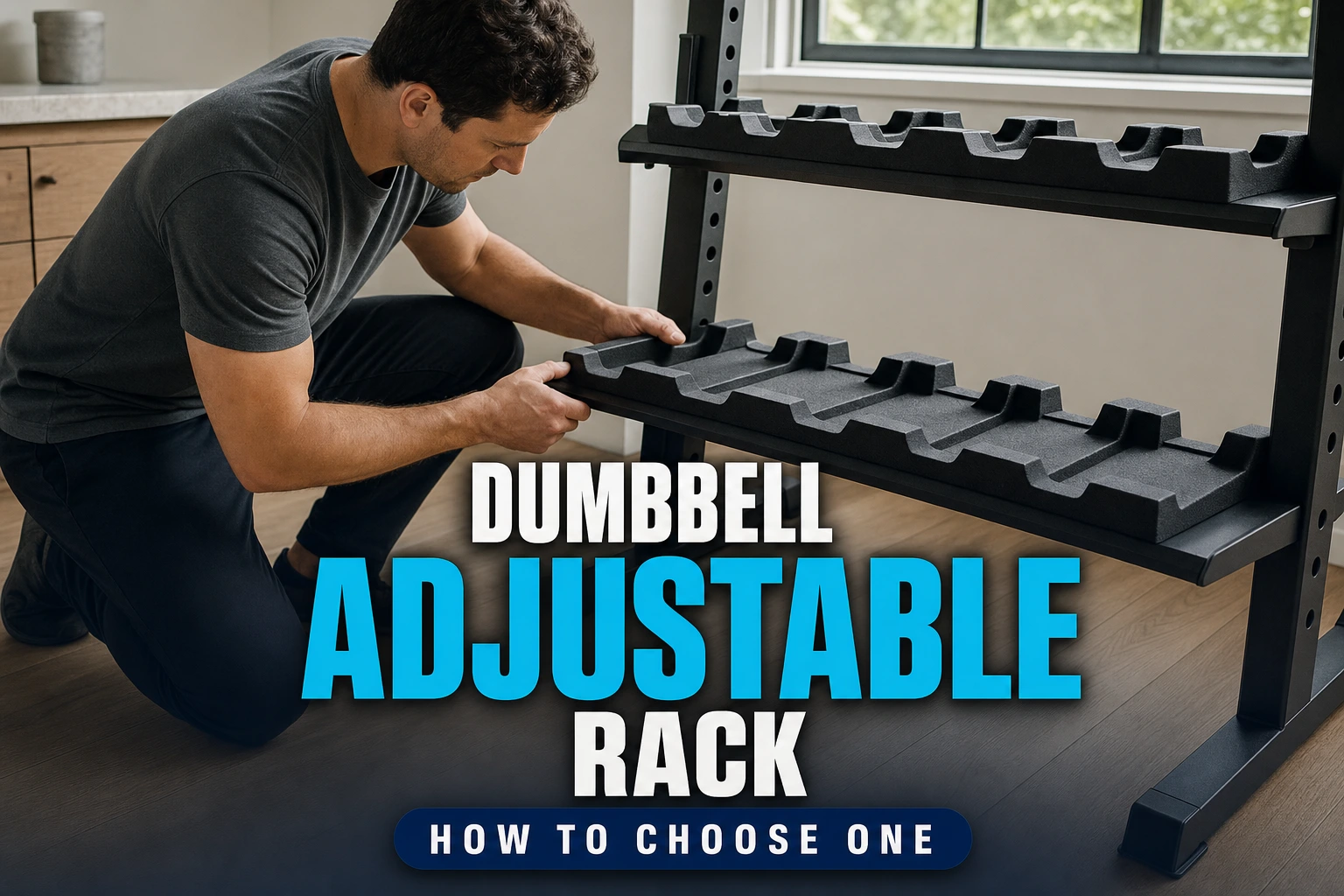
Choose a dumbbell adjustable rack by checking compatibility with your dumbbells and docking trays, load capacity, dimensions, stability, pickup height and floor protection.
This article is informational and does not place shopping buttons in the story. Related buying guides may include affiliate links.
As an Amazon Associate I earn from qualifying purchases. This does not affect the price you pay. Affiliate disclosure
On this page10 sections
- 1The short answer
- 2How Do You Choose the Right Dumbbell Adjustable Rack?
- 3Check Load Capacity, Frame Construction and Stability
- 4Measure the Footprint and Working Clearance
- 5Compare Pickup Height, Shelf Angle and Tray Retention
- 6Choose Between Universal Shelves and Dedicated Mounts
- 7Review Floor Protection, Mobility and Assembly
- 8Use a Final Checklist Before You Decide
- 9Frequently asked
- 10Sources
The short answer
- Confirm exact brand compatibility to ensure the weight cradles align perfectly with your adjustable dumbbells.
- Look for heavy-duty steel framing to support heavy weight loads without tipping or shaking.
- Measure your room dimensions and choose a compact, angled frame if floor space is limited.
To choose the right dumbbell adjustable rack, first confirm that it fits your dumbbells and their original docking trays. Then compare the rack’s rated capacity with the combined maximum weight of both dumbbells, measure its footprint, and check its stability, pickup height, tray retention and floor protection.
Adjustable dumbbells often use a base or tray during weight selection, so the storage setup must support that component securely. Some stands accept the manufacturer’s original trays, while others use model-specific mounts. A general-purpose shelf may work only if its dimensions, load rating and edge design suit the complete docked units.
The right choice therefore depends less on appearance than on verified measurements. Use this guide to create a shortlist, then consult our adjustable dumbbell rack comparison for six options assessed against practical buying criteria.
How Do You Choose the Right Dumbbell Adjustable Rack?
Start with compatibility, because a strong rack is still unsuitable if the dumbbells cannot dock and release correctly. Record the brand and exact model of your adjustable dumbbells, then measure each complete unit in its original tray. Compare its length, width and height with the stand’s usable platform dimensions rather than relying on the rack’s overall dimensions.
Check whether the rack requires you to transfer or attach the original trays. If attachment is required, confirm that the shelf has suitable mounting points and that installation does not obstruct the dumbbells’ selection controls. A model-specific stand may provide a close fit, but a universal shelf can be more adaptable if you replace your dumbbells later.
Garage Gym Reviews’ guide to adjustable dumbbells identifies ease of use and adjustment mechanism as relevant selection considerations. Applied to a rack, that means the stand should let you dock each dumbbell fully and operate its selector without interference. Do not assume that “universal” means every dumbbell system fits.
Check Load Capacity, Frame Construction and Stability
Add together the maximum selectable weight of both dumbbells, including any removable parts that remain in their trays. The rack’s stated load capacity must cover that total. Use the manufacturer’s rating rather than estimating strength from the stand’s appearance, frame weight or marketing photographs.
Frame material and joint design also affect how secure the stand feels. Steel gauge can help compare products when manufacturers publish it: with steel gauge, a lower gauge number generally denotes thicker sheet steel. Gauge alone, however, does not establish the strength of an assembled rack. Frame geometry, fasteners, welds, feet and shelf support all contribute to stability.
Look for a broad, level base, secure hardware and feet that sit evenly on your flooring. After assembly, tighten the fasteners according to the instructions and check for rocking before loading the stand. Choose a rated, stable frame rather than relying on an unsupported “heavy-duty” label. The six adjustable dumbbell racks compared guide can help you examine these differences across designs.
 See the picks in our buying guide
Measure the Footprint and Working Clearance
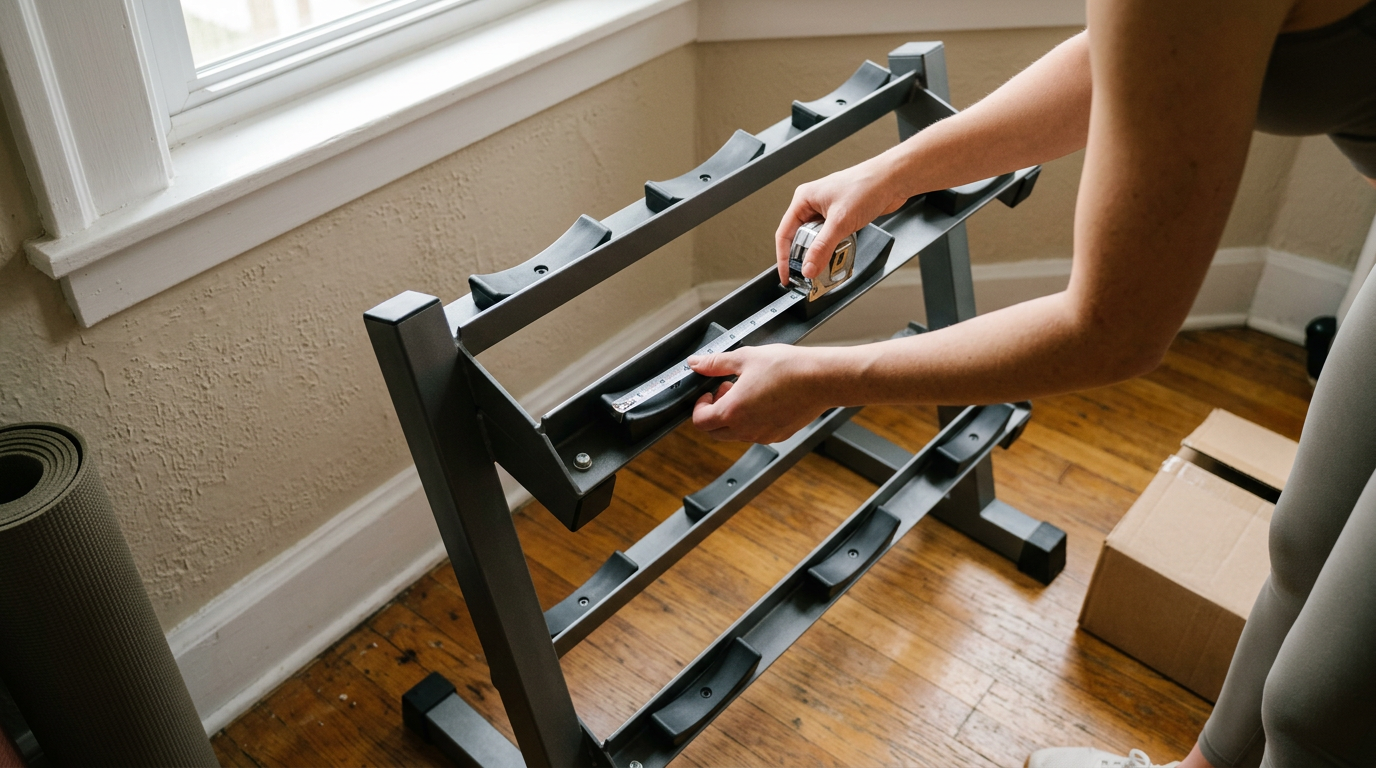
Measure the intended space before ordering. A rack’s footprint is its floor-level width and depth, but those figures do not always show how much room you need to use it. Account for projecting trays, angled shelves, wheels and the path your hands and dumbbells follow during pickup and docking.
Use painter’s tape to mark the listed footprint on the floor. Stand in front of the outline and rehearse the movement without weights. Make sure you can approach the handles squarely, lift without hitting a wall or bench, and return each dumbbell without twisting around other equipment. Leave enough room to reach adjustment controls and inspect the trays.
A vertical or narrow-column stand can conserve floor area, while a wider shelf-style rack may provide more room around the trays. Choose the smallest design that still permits an uncomplicated pickup and return. If the stand has wheels, include the caster sweep and handle position in your measurements.
Compare Pickup Height, Shelf Angle and Tray Retention
A suitable stand should position the handles where you can reach them comfortably and consistently. There is no single correct pickup height for every user, so compare the listed shelf height with your stature and preferred lifting position. If possible, reproduce that height with a stable household surface and test the unloaded movement before deciding.
Shelf angle matters because adjustable dumbbells usually need to enter their bases along a particular path. A slight tilt may make the handles easier to reach, but too much tilt can complicate alignment for some tray systems. Confirm that the dumbbell can be removed and returned without catching plates, selectors or tray edges.
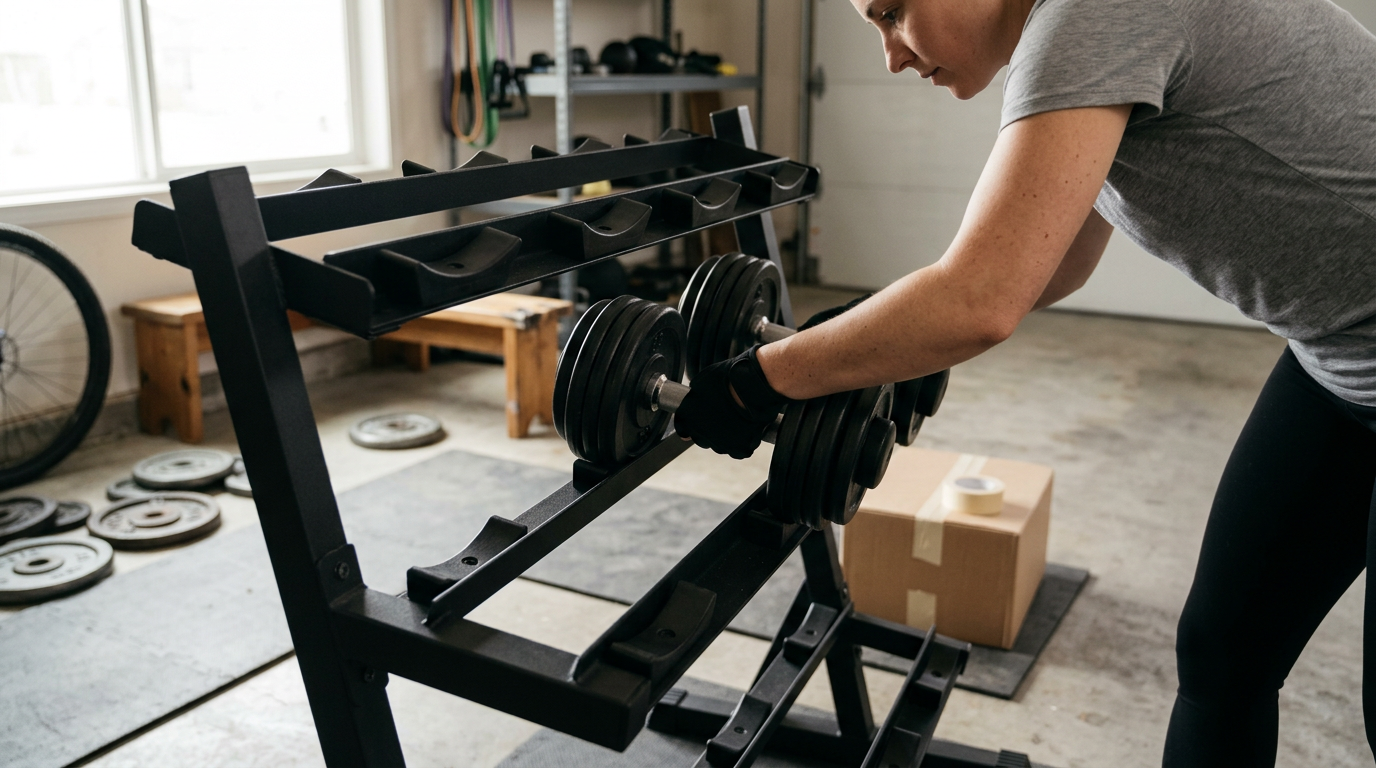
Also inspect tray retention: the method that stops a base from shifting as the dumbbell is lifted. Raised edges, straps, mounting hardware or shaped platforms can all serve this purpose, depending on the design. The tray should remain in place without obstructing the adjustment mechanism. Rehabmart’s guide to dumbbell sets with racks similarly treats storage design, space and user needs as connected buying considerations.
Choose Between Universal Shelves and Dedicated Mounts
Universal and dedicated stands solve different problems. A universal flat shelf can accept a wider range of equipment if its usable dimensions and capacity are sufficient. It may also remain useful after a future dumbbell change. The trade-off is that the original bases may need to be secured separately, and a flat shelf may offer less lateral restraint than a shaped mount.
A dedicated mount is designed around a particular tray or dumbbell family. That can simplify alignment and reduce unnecessary movement, but compatibility may be limited to named models. Verify the exact model rather than assuming that every product from one brand uses the same base.
Consider how long you expect to keep your current dumbbells and whether you want the rack to store anything else. Choose a dedicated mount for verified model-specific fit, or a universal shelf for flexibility—provided the trays can be secured. Our guide comparing six adjustable dumbbell rack picks provides a next step once you know which format suits your setup.
Review Floor Protection, Mobility and Assembly
The rack’s contact points should suit the floor beneath it. Rubber or polymer feet can help prevent direct metal contact with hard flooring, while a protective mat may be useful where the manufacturer permits one. On carpet, make sure the stand remains level and does not rock as the pile compresses.
Casters make repositioning easier, but mobility introduces more components to inspect. Look for a locking mechanism and confirm that the wheels are rated as part of the assembled stand. Lock them before handling the dumbbells, and avoid placing a mobile rack on a sloped surface. A fixed-foot design may be preferable if the stand will rarely move.
Assembly quality matters as much as the parts. Follow the specified sequence, use every supplied fastener and do not substitute hardware unless the manufacturer authorizes it. Check that shelves are oriented correctly and that bolts do not project into the trays. Reinspect the frame periodically for loose hardware, damaged feet or tray movement.
Use a Final Checklist Before You Decide
Before selecting a rack, write down the dumbbell model, the dimensions of each dumbbell in its tray, the combined maximum load and the available floor area. Compare those details directly with the rack manufacturer’s specifications. If any compatibility or capacity information is missing, seek clarification rather than filling the gap with an estimate.
Then review everyday use. Can you reach the selectors? Do the trays stay still? Is there room for your hands? Can the stand sit level without blocking a doorway, bench or walking route? If it moves, do the casters lock? If it is fixed, do the feet suit your floor?
Finally, consider future use. A proprietary stand can be practical for a long-term dumbbell setup, while a properly sized universal stand may accommodate later changes. Prioritize verified fit, adequate rated capacity and stable access over extra storage or styling. Once your checklist is complete, use the Best Dumbbell Adjustable Rack: 6 Picks Compared buying guide to narrow your options.
Frequently asked
Sources
- How to Choose an Adjustable Dumbbell Set for Your Home Gym
- Your Guide to Finding the Perfect Dumbbell Set with Rack
- Tested By Fitness Experts: 10 Best Adjustable Dumbbells (2026) | Garage Gym Reviews
- The Ultimate Guide to Choosing the Right Dumbbell Weight
- Best Adjustable Dumbbells for Home Workouts? Expert Guide to Choose
- Dumbbells 101: The Ultimate Reference Guide to Selection and Performance

As an Amazon Associate I earn from qualifying purchases. This does not affect the price you pay. Affiliate disclosure