
How to Choose the Right Sonos Dolby Atmos Soundbar
Choose a Sonos Dolby Atmos soundbar by matching its size and height-channel design to your room, ceiling, TV connection and future speaker plans.
This article is informational and does not place shopping buttons in the story. Related buying guides may include affiliate links.
As an Amazon Associate I earn from qualifying purchases. This does not affect the price you pay. Affiliate disclosure
On this page9 sections
- 1The short answer
- 2How do you choose the right Sonos Dolby Atmos soundbar?
- 3Understand physical and virtual Dolby Atmos
- 4Check HDMI ARC, eARC and source compatibility
- 5Match the soundbar to your room and ceiling
- 6Choose an appropriate size and listening profile
- 7Plan for a subwoofer and rear speakers
- 8Use a final pre-selection checklist
- 9Frequently asked
The short answer
- Assess room size first to decide between virtual height channels and dedicated upward-firing physical speaker drivers.
- Confirm your television has an eARC port to transmit uncompressed Dolby Atmos signals to the soundbar.
- Determine your expansion plans since some compact bars pair better with smaller, less expensive subwoofers.

To choose the right Sonos Dolby Atmos soundbar, match the bar’s size and Atmos approach to your room, then confirm that your TV has HDMI ARC or eARC. Prioritise fit, ceiling shape, connectivity and expansion plans rather than choosing on size alone. Compact designs suit limited spaces, while larger designs may provide wider coverage and dedicated upward-firing drivers. For model-by-model differences, see our comparison of five Sonos Dolby Atmos soundbars.
How do you choose the right Sonos Dolby Atmos soundbar?
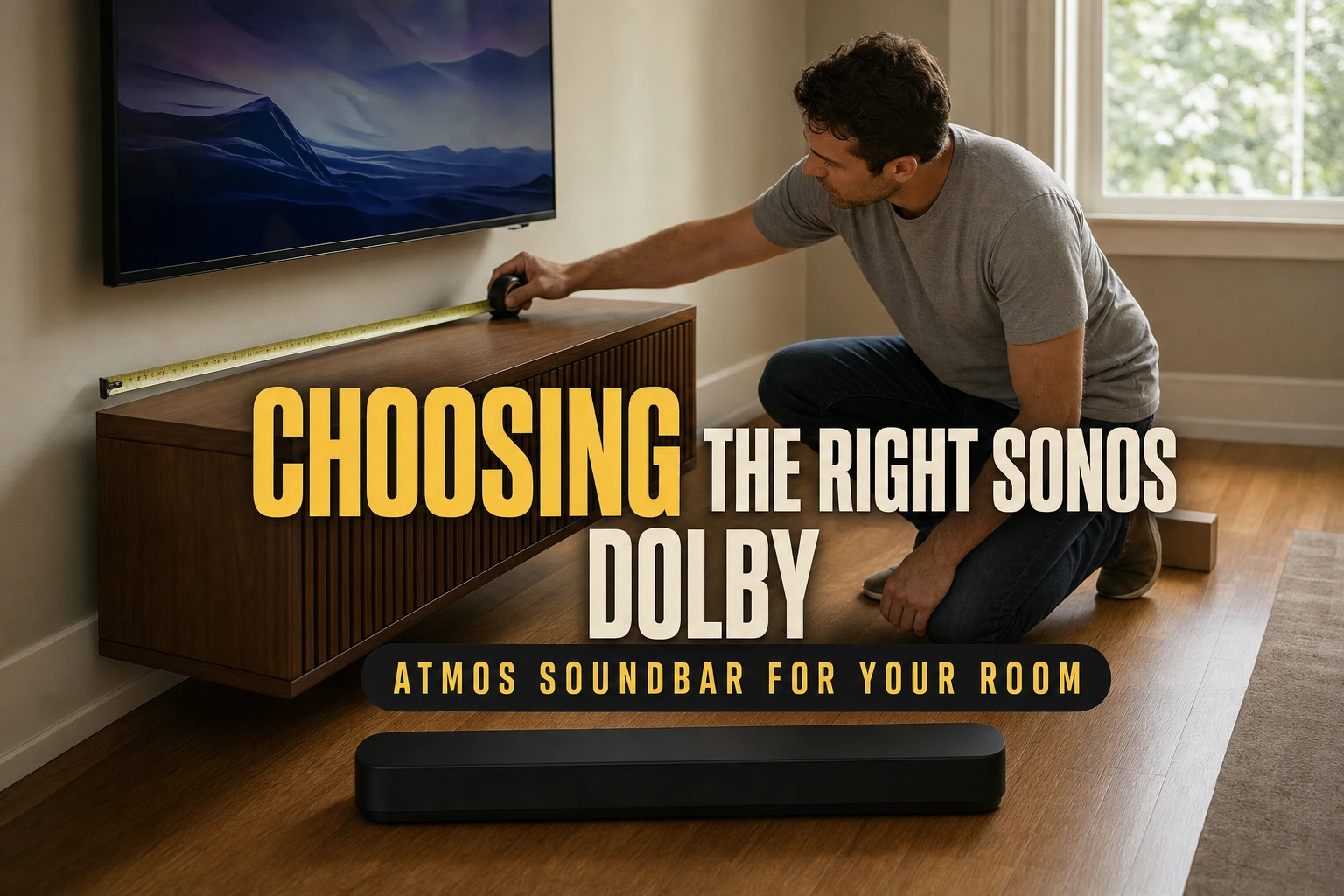
Start by measuring the space beneath your TV and noting your usual seating distance. Next, inspect the ceiling: a flat, unobstructed surface is generally better suited to reflecting sound from upward-firing drivers than a steeply sloped or heavily textured ceiling. Check whether the TV has HDMI ARC or HDMI eARC, and identify which devices supply your films, programmes and games. Then decide whether the system may eventually include a subwoofer or rear speakers. These checks help you choose between a compact soundbar that uses virtual height processing and a larger design with dedicated height drivers. The practical rule is to match the soundbar to the room and source equipment, not simply to the television’s screen size. Once you have documented those requirements, use the Sonos Dolby Atmos soundbar buying guide to compare suitable models.
Understand physical and virtual Dolby Atmos
Dolby Atmos is an object-based audio format: compatible soundtracks can assign sounds a position in a three-dimensional sound field rather than limiting every sound to a fixed speaker channel. A soundbar then reproduces or approximates those positions with its drivers and audio processing. Some designs use dedicated upward-firing drivers to direct sound toward the ceiling so that reflections create a sense of height. More compact designs may use digital signal processing and psychoacoustic techniques to suggest height without separate upward-facing drivers. Neither approach changes a difficult room into a purpose-built cinema. Physical height drivers depend more heavily on suitable placement and ceiling reflections, while virtual processing can be less demanding about ceiling geometry. The perceived result also depends on the soundtrack, seating position, room furnishings and system configuration, so Atmos support alone does not describe how a soundbar will behave in your space.
 See the picks in our buying guide
Check HDMI ARC, eARC and source compatibility
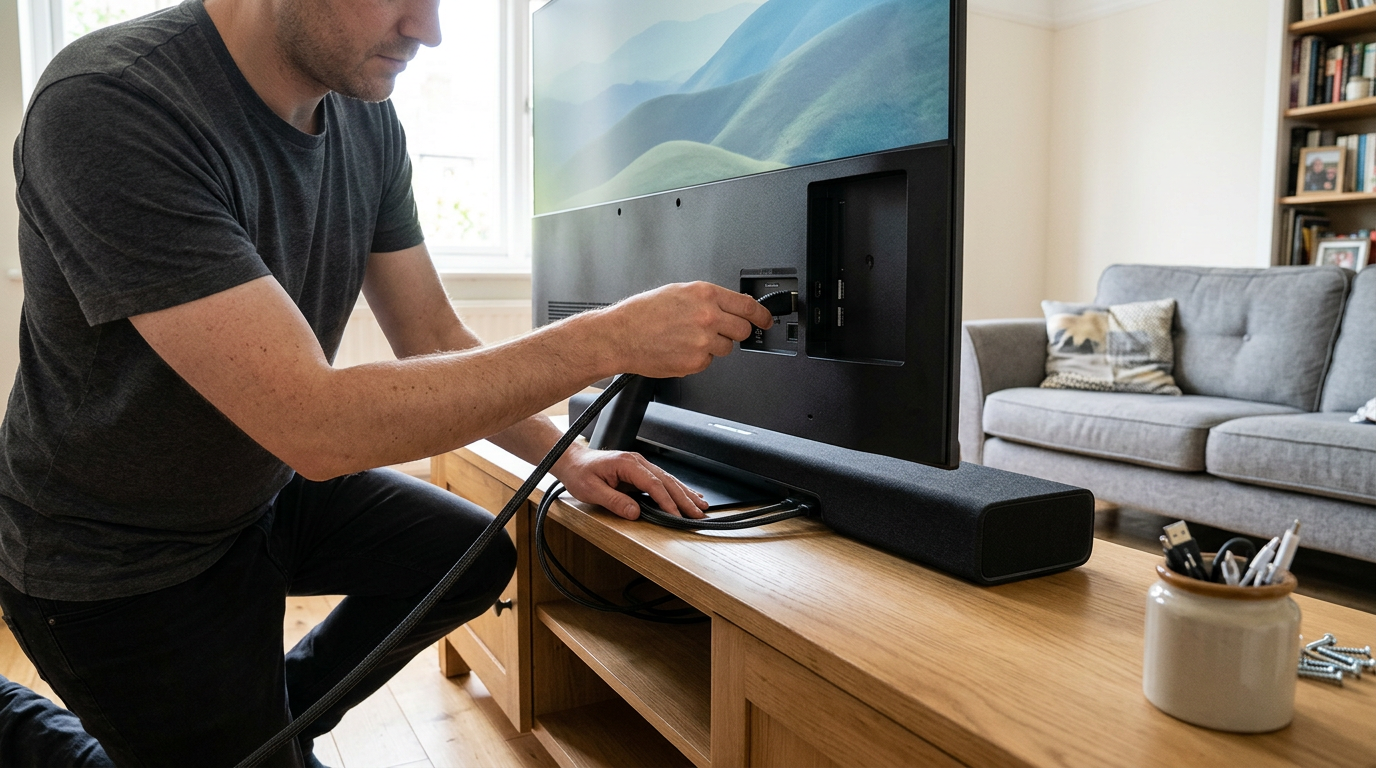
Before choosing a soundbar, examine the television’s connection panel and audio settings. Sonos home-theatre soundbars connect through the TV’s audio-return connection, so look for an HDMI port labelled ARC or eARC. HDMI ARC can carry common compressed surround formats used by many streaming services, while eARC provides more bandwidth and can support additional high-quality formats when the TV, source device and content are compatible. An ordinary HDMI input without audio return is not interchangeable with ARC or eARC. Optical connections have more limited format support and do not carry Dolby Atmos. Compatibility is a chain: the programme must include an Atmos soundtrack, the playback app or device must output it, the television must pass it correctly, and the soundbar must receive it. Check every link in that chain before assuming that replacing the soundbar alone will produce Atmos playback.
Match the soundbar to your room and ceiling
Your room acts as part of the audio system. Measure the available width, depth and height on the stand, and check that the soundbar will not cover the screen, infrared receiver or TV feet. If wall mounting, account for the distance below the television and any nearby shelves. A flat ceiling with a clear path above the soundbar is more favourable to reflected height effects than a vaulted, steeply sloped or obstructed ceiling, although results vary by room. Side walls and large openings also affect reflected sound: an open-plan area may not behave like an enclosed room with symmetrical boundaries. Soft furnishings can reduce harsh reflections, while bare surfaces may make a room more reverberant. Evaluate the actual seating area, including whether listeners sit centrally or far to one side. Room-tuning features can adjust playback for the space, but they cannot remove physical obstructions or supply reflective surfaces that are not present.
Choose an appropriate size and listening profile
A compact soundbar can be a sensible fit for a bedroom, office or smaller living area where furniture space and moderate listening levels matter most. A larger bar may provide broader front-channel separation and more output for a bigger seating area, but it also requires more physical clearance. Avoid treating television size as the only guide: two rooms with the same screen can have very different seating distances, ceiling shapes and acoustic conditions. Consider what you play most often. Dialogue-heavy television places emphasis on clear speech, while films and games may benefit more from convincing spatial effects and stronger low-frequency support. Music listening may make tonal balance and stereo presentation more important. Choose for your normal listening habits, not an occasional maximum-volume scenario. If several people regularly watch together, consider how wide the seating area is and whether off-centre listeners still need clear dialogue and a coherent soundstage.
Plan for a subwoofer and rear speakers
A Sonos Dolby Atmos soundbar can operate without a separate subwoofer or rear speakers, but your future plans may affect the right starting point. A compatible subwoofer handles low-frequency material separately, while rear speakers add sound from behind the seating position. Those additions require power sockets, floor or wall space, and suitable placement. They also change the total footprint and complexity of the system, so decide early whether a single-bar setup is the long-term goal or only the first stage. Do not assume every older Sonos speaker can become a surround speaker; compatibility depends on the specific products and the Sonos software platform they use. Confirm current pairing support in Sonos documentation before building a plan around equipment you already own. If expansion matters, compare the relevant configurations in Best Sonos Dolby Atmos Soundbars: 5 Picks Compared after narrowing your room and connectivity requirements.
Use a final pre-selection checklist
Before selecting a model, write down six details: the soundbar space available; the distance to the main seat; the ceiling shape; the TV’s ARC or eARC connection; the devices and apps supplying content; and any intended subwoofer or surrounds. Confirm that the TV can pass the audio formats used by those sources, and check whether its audio settings require eARC or passthrough to be enabled. Decide whether dedicated upward-firing drivers are practical in the room or whether a compact virtual-height design is a better fit. Finally, review cable routes, power sockets and ventilation around the TV furniture. This process prevents a technically capable soundbar from being undermined by placement or connection limits. Room fit and signal compatibility should come before feature count. With that shortlist in hand, consult the five-model Sonos Dolby Atmos comparison for the final model choice.
Frequently asked

As an Amazon Associate I earn from qualifying purchases. This does not affect the price you pay. Affiliate disclosure