
How Do You Choose the Right 40-Ounce Tumbler?
Choose the right 40-ounce tumbler by matching its lid, cupholder fit, handle, insulation, materials, and cleaning requirements to your routine.
This article is informational and does not place shopping buttons in the story. Related buying guides may include affiliate links.
As an Amazon Associate I earn from qualifying purchases. This does not affect the price you pay. Affiliate disclosure
On this page9 sections
- 1The short answer
- 2How Do You Choose the Right 40-Ounce Tumbler?
- 3Evaluate the Lid and Drinking Mechanism
- 4Check Base Diameter and Cupholder Compatibility
- 5Compare Insulation Without Relying on Headline Claims
- 6Assess Handle Ergonomics and Full-Weight Balance
- 7Review Materials, Finish, and Cleaning Needs
- 8Use This 40-Ounce Tumbler Checklist
- 9Frequently asked
The short answer
- Look for a tapered base under 3 inches [7.6 cm] to fit standard vehicle cupholders.
- Decide between splash-resistant straw lids and fully leakproof screw-top lids for secure travel.
- Prioritize double-wall vacuum insulation to maintain cold temperatures for up to 24 hours.
To choose the right 40-ounce tumbler, start with where and how you will use it. Pick a lid that suits your drinking style and required spill resistance, measure your cupholder, and assess the handle when the tumbler is full. Then compare insulation, materials, dimensions, stability, and cleaning instructions.
While carrying a large volume of water can reduce how often you need to refill, finding a suitable 40-ounce tumbler with a handle requires looking past colors or branding. The physical dimensions, lid mechanics, and handle ergonomics dictate whether your vessel is a helpful tool or a bulky chore.
No single design suits every setting. A straw tumbler may be convenient at a desk, while a fully sealed bottle is usually more appropriate inside a bag. By focusing on practical utility and construction, you can identify which features align with your daily routine.
The quick version
- Define the main use
- Measure the storage space
- Pick the drinking interface
- Inspect the lid
- Assess the handle and balance
- Read the care guidance
How Do You Choose the Right 40-Ounce Tumbler?
Begin by identifying the tumbler’s main environment: a desk, car, gym, outdoor space, or bag. That decision narrows the field quickly. For desk and car use, prioritize one-handed drinking, a comfortable handle, and cupholder compatibility. For a bag or active commute, place greater weight on a fully closing lid and a shape that is easy to carry.
Next, consider what you normally drink. A straw opening suits frequent sipping, while a wider opening can make faster drinking and adding ice easier. If you switch between both, look for a lid designed to support more than one drinking position.
Finally, check the practical details: the tumbler’s base diameter, overall height, empty weight, care instructions, replacement-part availability, and whether the lid can be taken apart for cleaning. These points often matter more in daily use than decorative finishes. If a handled design fits your routine, use our guide to 40-ounce tumblers with handles to compare the category.
Evaluate the Lid and Drinking Mechanism
The drinking lid represents the primary way you interact with your hydration vessel. Many large-capacity tumblers feature lids that accommodate a reusable straw, a wider opening for direct drinking, or a more closed position. Choosing how you prefer to consume your beverages dictates which lid construction will work best for your lifestyle.
If you plan to use your tumbler primarily while sitting at a desk or driving, a straw opening provides quick access. However, an exposed straw opening should not be treated as leakproof; liquid may escape if the container tips over. For a tumbler that will travel in a bag, look for a folding spout, threaded closure, or another design that closes the drinking path completely.
Lid retention also matters. A threaded lid screws onto the vessel, while a press-fit lid relies on friction and a gasket. Examine the gasket, closure, straw opening, and any moving parts. A lid with fewer inaccessible crevices may be easier to clean thoroughly.
 See the picks in our buying guide
Check Base Diameter and Cupholder Compatibility
While a large liquid capacity is convenient, a wide tumbler can be difficult to transport. To address this issue, many designs use a tapered base that narrows toward the bottom. This can help a high-capacity tumbler fit a cupholder without reducing the width of the upper body.
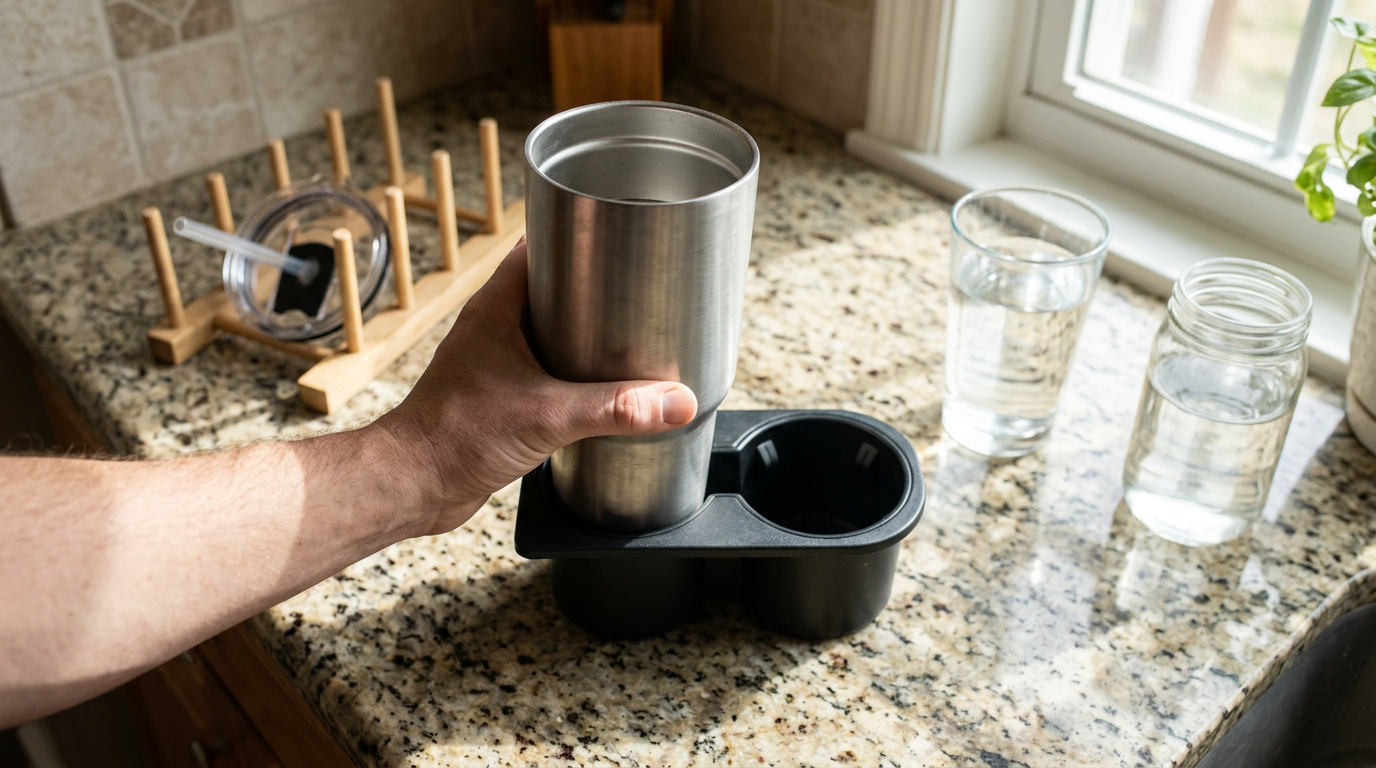
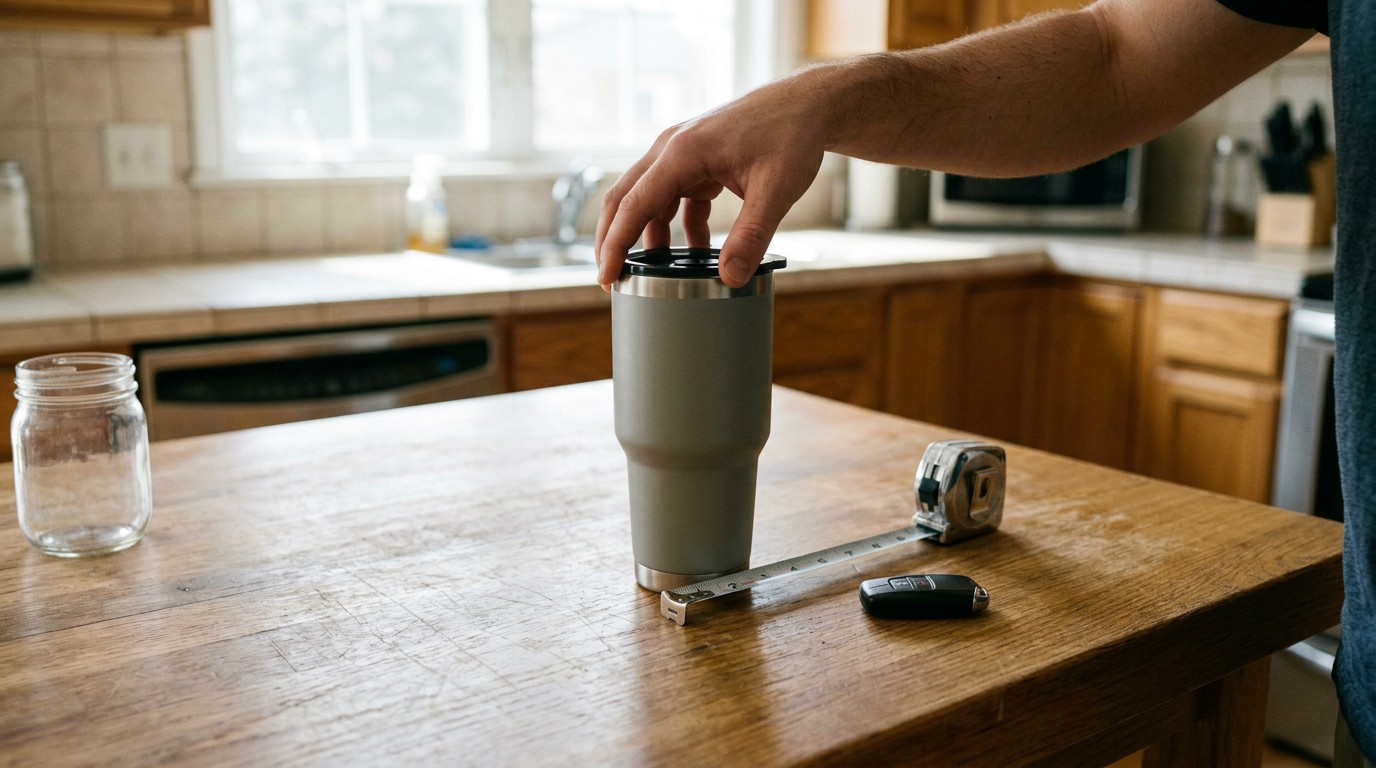
Do not assume that every tapered design fits every vehicle. Cupholders differ in diameter, depth, shape, and surrounding clearance. Measure the narrowest useful width of your cupholder and note whether nearby controls, armrests, or the passenger seat limit space around the tumbler’s wider upper section. Compare those measurements with the manufacturer’s stated dimensions.
Height and weight distribution are equally important. A tall tumbler may become top-heavy when filled, particularly if only a small part of its base sits inside a shallow holder. Check that it rests on the bottom rather than balancing on the rim. The handle should also clear the console so the tumbler can sit at full depth.
Compare Insulation Without Relying on Headline Claims
The common construction for an insulated steel tumbler is double-wall vacuum insulation. It uses inner and outer walls separated by a low-pressure space that slows heat transfer. This construction can also reduce condensation on the exterior when the tumbler holds a cold drink.
Thermal performance varies with the lid, starting beverage temperature, amount of ice, outdoor conditions, and how often the tumbler is opened. For that reason, advertised retention times are not directly comparable unless brands use the same method and conditions. Treat them as manufacturer claims rather than a promise of identical everyday performance.
The lid can be a significant source of heat transfer because it is not built like the insulated steel body. A large straw opening or frequent opening may shorten the time a drink remains cold. If temperature retention matters, compare the complete vessel design instead of focusing only on the wall construction. Pre-chilling the tumbler and limiting unnecessary opening can also support more consistent performance.
Assess Handle Ergonomics and Full-Weight Balance
A 40-ounce tumbler becomes substantially heavier once it contains a drink and ice, so handle comfort and balance deserve close attention. A handle that feels acceptable on an empty tumbler may press into the fingers or twist the wrist once the vessel is full.
Consider the opening size, grip thickness, edge shape, and distance between the handle and body. Your fingers should fit without being compressed against the tumbler. People with larger hands or limited grip strength may prefer more clearance and a broader gripping surface. If you can inspect a tumbler in person, hold it both close to your body and at arm’s length, ideally with weight inside it.
The attachment position affects balance and cupholder use. A high-mounted handle can provide clearance above a console, but the exact fit depends on the vehicle. Also inspect attachment points for gaps that may collect residue. For models that will stay mainly on a desk, a stable handle can matter more than a compact silhouette. Our 40-ounce handled tumbler comparison covers designs intended for this use.
Review Materials, Finish, and Cleaning Needs
Stainless steel is widely used for insulated tumblers because it is durable and suitable for reusable drinkware. Still, the user-facing details vary. Inspect the inside for hard-to-reach seams, and consider whether the opening is wide enough for your hand, brush, or preferred ice. If retaining flavors or odors is a concern, a lid that disassembles can be as important as the body material.
The external finish is often a powder coating that adds texture and color. Care requirements differ, so check the manufacturer’s instructions rather than assuming the finish or lid is dishwasher-safe. Some lids contain small gaskets or sliding parts that need to be removed periodically for cleaning. Before choosing, confirm that you can reassemble those components correctly and obtain replacements if the manufacturer offers them.
Also inspect the base. A non-slip pad may reduce noise and movement on a desk, but it can affect cupholder fit and may require separate cleaning. Choose a design you can clean consistently, because a complicated lid may become frustrating even if its drinking mechanism is convenient.
Use This 40-Ounce Tumbler Checklist
Selecting a suitable tumbler does not have to be a guessing game. By taking a systematic approach, you can evaluate a container against your routine before making a decision.
- Define the main use. Decide whether the tumbler will stay upright at a desk or in a car, or travel inside a bag.
- Measure the storage space. Record your cupholder’s diameter, depth, and surrounding clearance, or measure the bottle pocket where the tumbler will sit.
- Pick the drinking interface. Choose a straw for frequent sipping, a direct-drink opening for faster flow, or a fully closing cap for transport.
- Inspect the lid. Check how it attaches, whether the drinking path closes, and whether the gasket and moving parts can be removed for cleaning.
- Assess the handle and balance. Consider finger clearance, grip shape, attachment position, and comfort under realistic weight.
- Read the care guidance. Verify cleaning instructions for the body, coating, lid, straw, and seals.
- Compare dimensions and parts. Review overall height, base width, empty weight, and the availability of compatible replacement lids, straws, or gaskets.
If your checklist points toward a handled model, continue with the Best 40-Ounce Tumblers with Handles guide.
Frequently asked

As an Amazon Associate I earn from qualifying purchases. This does not affect the price you pay. Affiliate disclosure