
How to Choose the Right Keurig Coffee Maker for Your Home
Learn how to select the perfect Keurig coffee maker by comparing reservoir sizes, brewing features, footprint, and specialty milk options.
This article is informational and does not place shopping buttons in the story. Related buying guides may include affiliate links.
As an Amazon Associate I earn from qualifying purchases. This does not affect the price you pay. Affiliate disclosure
On this page8 sections
- 1The short answer
- 2Assess Your Daily Water Reservoir Needs
- 3Evaluate the Machine Footprint and Kitchen Space
- 4Match Customization Features to Your Taste
- 5Step-by-Step Guide to Selecting Your Ideal Model
- 6Specialized Features for Milk Frothing and Specialty Drinks
- 7Which K-Cup Machine Style Should You Pick?
- 8Frequently asked
The short answer
- Assess water reservoir capacity based on how many cups your household drinks daily without refilling.
- Select slim or mini models if counter space is tight, or larger models for advanced customization.
- Choose specialty milk-frothing models only if you regularly drink lattes, cappuccinos, or iced espresso drinks.
To choose the right Keurig, you must match the water reservoir capacity to your daily household consumption and decide if you need specialty features like temperature control, strength adjustment, or built-in milk frothing.
Finding the ideal brewer from the extensive K-series lineup requires looking past the basic promise of quick coffee. While every model uses standard pods, they differ in brewing speed, physical size, temperature customization, and milk preparation capabilities. Making the wrong choice can lead to crowded countertops or constant, annoying trips to the kitchen sink.
Navigating these design differences helps you avoid overpaying for professional features you will never use, or buying an underpowered machine that requires constant refills. Let's look at the key performance factors so you can find the perfect model highlighted in our Best K-Cup Coffee Makers: Buying Guide.
The quick version
- Measure your counter space
- Calculate your daily cup count
- Decide on specialty milk drinks
- Choose your level of customization
- Verify pod compatibility options
Assess Your Daily Water Reservoir Needs
The size of the water reservoir is often the single most important factor in your daily satisfaction with a pod coffee maker. Single-serve models with no dedicated reservoir require you to pour fresh water into the back of the machine before every single brew. While this ensures fresh water for every cup, it adds an extra step to your morning routine that can feel tedious when you are in a rush.
Multi-cup reservoirs allow you to brew several drinks back-to-back before refilling. A standard compact model might feature a 46-ounce [1.36-liter] or 48-ounce [1.42-liter] water tank, which typically provides four to five average-sized cups of coffee. If you live in a multi-coffee-drinker household, look for premium models that offer 75-ounce [2.22-liter] reservoirs or even larger.
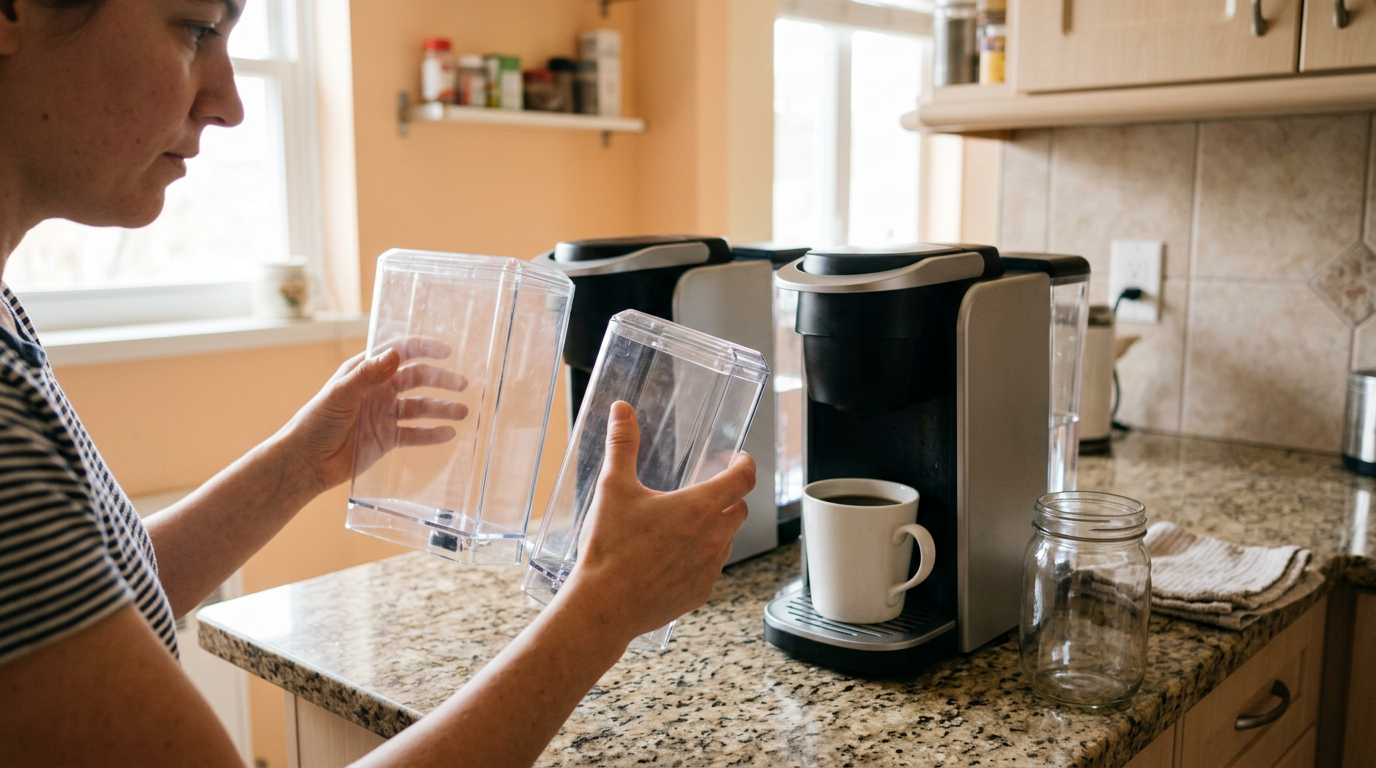
Beyond sheer volume, consider the positioning and mobility of the reservoir itself. Some models feature removable tanks with sturdy carrying handles, making them incredibly easy to carry to the sink. Other models have fixed water wells that require you to bring a pitcher to the machine, which can easily result in spills if the unit is tucked under low-hanging cabinets. A larger water tank reduces the frequency of descaling alerts and simplifies your routine.
Evaluate the Machine Footprint and Kitchen Space
Kitchen counter space is valuable real estate, and pod coffee makers vary dramatically in their physical dimensions. Ultra-compact models are designed specifically for tight spaces, measuring less than five inches [12.7 cm] in width. These slim profile designs are excellent for small apartments, dorm rooms, or home office desks where every square inch matters.
However, selecting a smaller machine usually means sacrificing reservoir capacity and advanced temperature programming features. Larger machines can measure over ten inches [25.4 cm] wide and require significantly more counter area to accommodate milk frothers or dual-position water tanks. You must measure not only the width and depth of your designated space but also the vertical clearance of your cabinets.
Vertical clearance is a frequently overlooked issue when buying a pod machine because of how the lid opens. When you lift the handle to insert a pod, the top of the brewer opens upward, adding several inches to the machine's total height. If your cabinets sit low over your countertops, you may find yourself sliding the heavy machine forward every single time you want to brew a cup.
 See the picks in our buying guide
Match Customization Features to Your Taste
Basic pod machines operate on a simple one-touch mechanism that brews a standard cup of coffee at a fixed temperature and speed. While this simplicity is convenient, it offers no way to adjust the flavor profile to match your specific taste preferences. If you enjoy rich, dark roasts, a basic machine may produce a cup that feels too weak or watery.
To solve this, advanced machines feature a dedicated bold or strong button. This setting slows down the water flow, allowing the hot water to remain in contact with the coffee grounds for a longer duration to extract more oils and solids. Some high-end models also feature MultiStream Technology, meaning MultiStream Technology uses five needles instead of one to saturate the coffee grounds evenly.
Temperature control is another premium feature that alters your coffee's flavor extraction. Standard models brew at a factory-set temperature, but advanced units let you adjust the heat within a range of 187°F [86°C] to 192°F [89°C]. Additionally, look for an iced coffee feature if you enjoy cold drinks; this setting starts hot to extract flavor and then tapers off to prevent melting your ice too quickly.
Step-by-Step Guide to Selecting Your Ideal Model
- Measure your counter space. Check both width and the vertical clearance needed to open the pod chamber lid.
- Calculate your daily cup count. Determine if a single-cup reservoir or a multi-cup water tank fits your morning routine.
- Decide on specialty milk drinks. Identify if you need an integrated hot/cold milk frother or just black coffee.
- Choose your level of customization. Select whether you want adjustable temperature, strength settings, or simple one-touch brewing.
- Verify pod compatibility options. Ensure the model supports reusable filters if you prefer using your own ground coffee.
This structured approach prevents you from buying a machine that is either too complicated for your needs or too basic for your taste. By systematically analyzing your physical kitchen space and your flavor preferences, you can narrow down the large catalog of brewers to the exact class of machine that fits your lifestyle.
Remember to also consider the ease of regular maintenance when going through these steps. Models with clear, removable parts and straightforward descaling indicators will save you hours of upkeep down the line. If you are ready to compare actual products, explore our curated list of top-performing options in the Best K-Cup Coffee Makers: Buying Guide.
Specialized Features for Milk Frothing and Specialty Drinks
For those who enjoy lattes, cappuccinos, and macchiatos, a standard black coffee brewer will not suffice. Specialty models in the "K" lineup feature built-in milk frothers that sit alongside the main brewing unit. These frothers use a spinning whisk mechanism to create hot or cold milk foam using fresh dairy milk, oat milk, or soy milk.
These specialty machines also include a unique "shot" button. This function brews a highly concentrated, two-ounce [59-milliliter] shot of coffee using a standard pod. While it is not true high-pressure espresso, this concentrated brew mimics the strength of espresso well enough to balance the large volume of milk used in lattes and cappuccinos.
If you only drink milk-based specialty drinks occasionally, buying a machine with a built-in frother might not be worth the extra counter space and cleaning effort. The milk frothing cup must be washed after every use to prevent dairy residue from baking onto the metal. In these cases, buying a standard brewer and a separate, standalone frother is often a more flexible approach.
Which K-Cup Machine Style Should You Pick?
- Compact and Budget: Models like the mini series are incredibly narrow, making them perfect for small kitchens, but they offer limited water capacity and zero temperature adjustments.
- Balanced Mid-Range: Standard models provide a generous water reservoir for multi-cup brewing while maintaining a relatively simple interface without advanced settings.
- Premium Customization: The elite and supreme series offer advanced multi-stream water needles, adjustable brew strengths, temperature controls, and high-capacity water tanks for ultimate control.
- Specialty Brewer: The cafe lines include an integrated milk frother and a shot-brewing feature, designed specifically for those who want to prepare coffeehouse drinks at home.
Which machine style should you pick for your kitchen? If you are the only coffee drinker in the household and want a quick cup with zero fuss, a compact or mid-range model will fit your routine perfectly without wasting space. These basic models are straightforward to operate and require very little programming or setup.
On the other hand, if you share your kitchen with multiple coffee lovers who all have different tastes, investing in a premium model with customizable profiles is the smartest path. This allows everyone to adjust their cup size, temperature, and boldness to match their individual preferences. For visual comparisons and comprehensive testing insights on these categories, consult our Best K-Cup Coffee Makers: Buying Guide.
Frequently asked
As an Amazon Associate I earn from qualifying purchases. This does not affect the price you pay. Affiliate disclosure